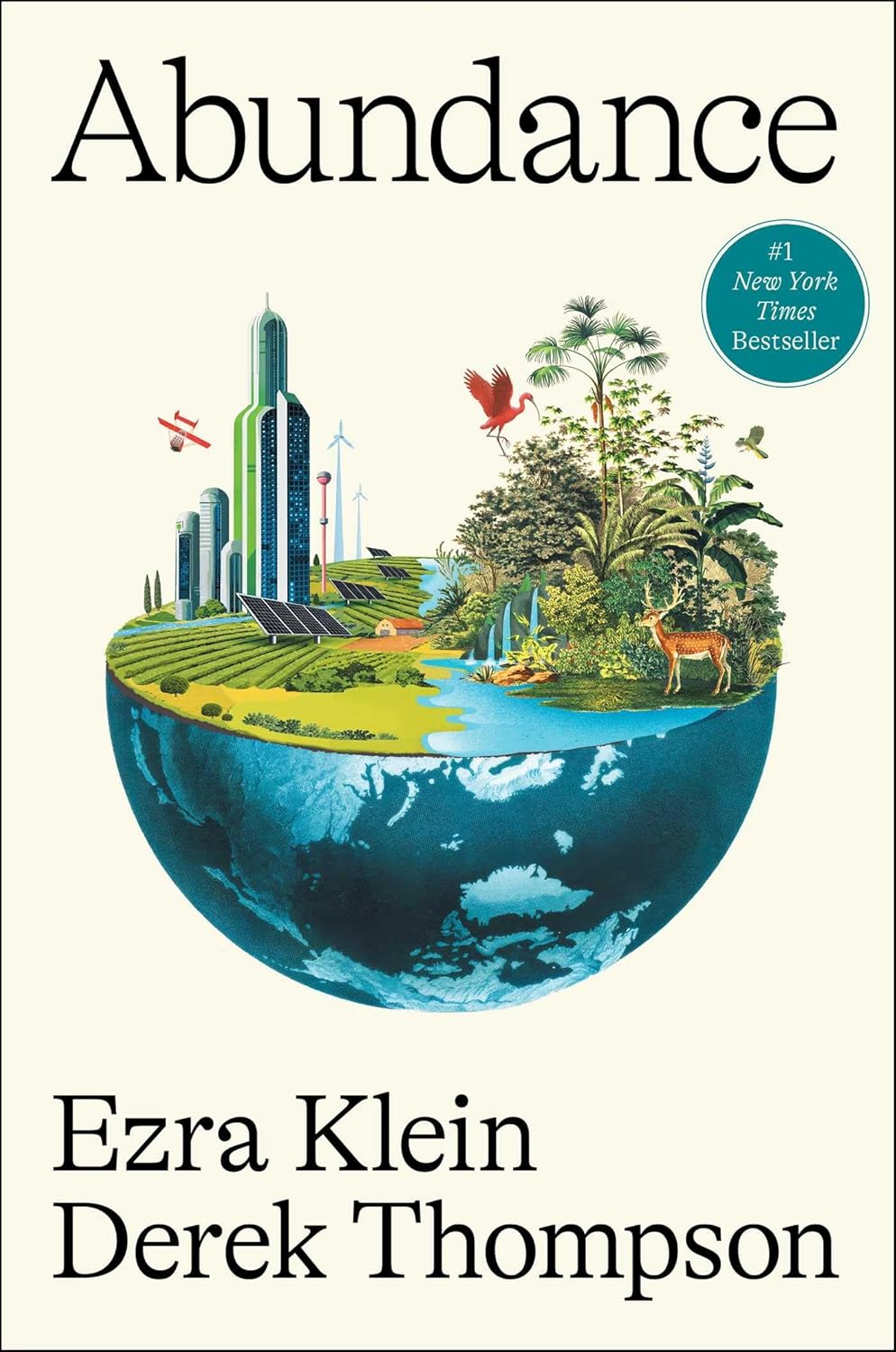
“Abundance” Challenges Democrats to Make Progress Work
Abundance, a new book by journalists Ezra Klein of The New York Times and Derek Thompson of The Atlantic, is a savvy critique of how Democrats, with the best of intentions, have fouled up governance at every level over the past 50 years. Their well-documented case studies illustrate how progressives have created layers of process that can bring government to a crawl, and even to a standstill. Abundance also offers a recipe to reorganize government operations to work better, rather than to bleed or eliminate them as Elon Musk’s DOGE “efficiency” experts have done.
What is needed, Klein and Thompson argue, is an abundance agenda that refines bureaucratic procedures to unfetter innovation and invention, and reawakens the pioneering American spirit that created opportunity and growth across the nation. If policymakers consider market strategies and expedite implementation of critical programs, they say, we can relieve the housing shortage, improve health care and life expectancy, stimulate clean energy and other technological innovation, revolutionize transportation and communication, and convey wealth and mobility through every sector of society.

Klein and Thompson marshal an enormous amount of data to make their points, tracking Democratic projects from the promise to the start-ups to the fades and, finally, abandonment. In California, for example, a plan initiated in 1982 during the first term of Gov. Jerry Brown to build a $2 billion “bullet train” from San Francisco to Los Angeles has yet to be built. Cost estimates now approach $100 billion as permit processes and environmental studies continue, but no usable rails are in place. Gov. Gavin Newsom renewed his support for the project in January, but the lack of progress is magnified by the fact that safe and convenient high-speed rail networks abound in Japan, China, France, Germany, Spain, Italy and many other countries. The best we have is the East Coast Amtrak Acela, fast but slower than bullet trains, and forced to share tracks with other trains.
What has happened to America’s technological leadership in the world? Our system just isn’t working, the authors say. They point to China as a nation that has surpassed the United States by quickly adapting clean-energy technology, particularly with electric vehicles. China manufactures more than 60 percent of all electric vehicles in the world, and more than 80 percent of batteries used in EVs. China’s quick pivot on clean energy is contrasted with President Biden’s efforts to stimulate EV and other clean energy technology with his Inflation Reduction Act, which has failed to produce more than 60 EV charging stations nationwide and includes projects hung up in regulatory hell, or likely to be abandoned by President Trump, who is an unreconstructed fossil fuel ally (“Drill, baby, drill.”)
Ironically, the solution may be illuminated by the remarkable program success of the first Trump administration, Operation Warp Speed, a public-private partnership that promoted mass production of multiple vaccines, using different technologies, based on preliminary evidence. The key to its success was avoiding time-consuming process and permitting requirements, giving project leaders authority to move ahead without delays. With federal support to counter the COVID pandemic, clinical trials helped rush effective vaccines into use in 10 months, not three years as experience predicted. While Trump today disavows the program because his MAGA coalition is overrun by vaccine deniers and science skeptics, it drove the successful global response to the pandemic that saved millions of lives.
Klein and Thompson report that the original research into the potential use of the mRNA technology for vaccines was developed by researchers Katalin Karikó and Drew Weissman at the turn of the millennia but was deemed too risky and unlikely to produce anything of value. The research was essentially shelved in 2005 when their paper was rejected by Nature and Science, and their appeals to the National Institutes of Health for funding were rejected. Operation Warp Speed resurrected the research and careers of Karikó and Weissman, as government funding set off a race between Moderna and Pfizer to develop mRNA vaccine to combat the COVID virus. Both were highly successful, and are modified for use as boosters today. As a result, Karikó and Weissman were awarded the Nobel Prize in Physiology or Medicine in 2023.
The biggest problem facing Democrats who want to follow the prescription laid out in Abundance, as Jonathan Chait writes in The Atlantic, is that it threatens the influence of powerful interest groups that constitute the Democratic Party. In fact, the heart and soul of liberal democracy over the past half-century has risen through organizations inspired by such consumer and environmental champions as Ralph Nader and Rachel Carson, as well as other social advocates who insist on and challenge impact statements and studies, delaying public works. The voices of the people who move the Democratic Party include members of labor unions, civil rights organizations, LGBTQ and other allied community groups, whose power is extended by solidarity and coalition work with other progressive social movements.
“Such progressives are not wrong to see the abundance agenda as a broader attack on their movement,” Chait writes. “Their theory of American politics depends on empowering the very groups the abundance agenda identifies as the architects of failure and barriers to progress.”
Among the barriers to progress cited by Klein and Thompson in Abundance is the National Environmental Policy Act (NEPA), which requires stringent impact studies before interstate projects are approved. The law took a hit May 29 with a unanimous ruling by the Supreme Court that limits the scope of NEPA in its requirements for a proposed 88-mile railway in Utah that would connect oilfields to a national rail network near the Colorado River, and then to refineries on the Gulf Coast. “The goal of the law,” Justice Brett Kavanaugh wrote for the majority, “is to inform agency decision making, not to paralyze it.”
While environmental groups reacted to the ruling with alarm, the decision could narrow the parameters of legal challenges to public works in the future, helping to accelerate projects. That doesn’t necessarily minimize the power of the environmental movement, given the imperative of protecting our planet to sustain life. It’s a question of balance, and Klein and Thompson argue that regulation is tipping too far toward stopping progress that is essential to ensure the survival of life on our planet, and our American way of life.
As a progressive committed to environmental protection, as well as social and economic justice for all, I hope the Democratic Party considers carefully how to integrate an abundance agenda into its platform for 2027 and beyond. Public interest groups have a critical role to play in a democracy, giving voice to citizens and their communities, which helps arbitrate how we can move forward to create a society of abundance. But it can be taken too far, as the second Trump administration demonstrates. The courts can be used to tie up worthwhile government work for as long as attorneys are paid to file appeals – particularly with a Supreme Court in league with those who oppose progress. And the true villains in the growing arteriosclerosis of government programs are billion-dollar corporations and their dark-money conglomerates, which expend vast sums to stop important public works that threaten profits.
Abundance doesn’t spend enough time focusing on the corporate culprit muddying government operations, perhaps because Klein and Thompson see the private sector playing a vital role in the rehabilitation of government. But the public interest is not well-served without an impartial arbiter to sort out the conflicts of interest, and decisions made based on the common good, not corporate profits. To Klein and Thompson, eager to reduce regulation and permitting to move the market engine forward, that problem is secondary. But I don’t believe the abundance agenda can be implemented without a counter those who would take all the abundance to themselves.
Still, this intelligent, well-written book is able to use a broad brush to paint a detailed portrait not only of the problems we face as a nation and as a society, but also how government can be used to usher in a bright new future for everyone. It’s ambitious, certainly, and also important. The arguments Klein and Thompson present are solidly grounded in their reporting and expertise. It’s especially potent as an audio book, with Klein and Thompson alternating to present their compelling case for government transformation. I recommend you give it a listen, or a good read. It will make you think.
I'd like to know what you think. Please reply …